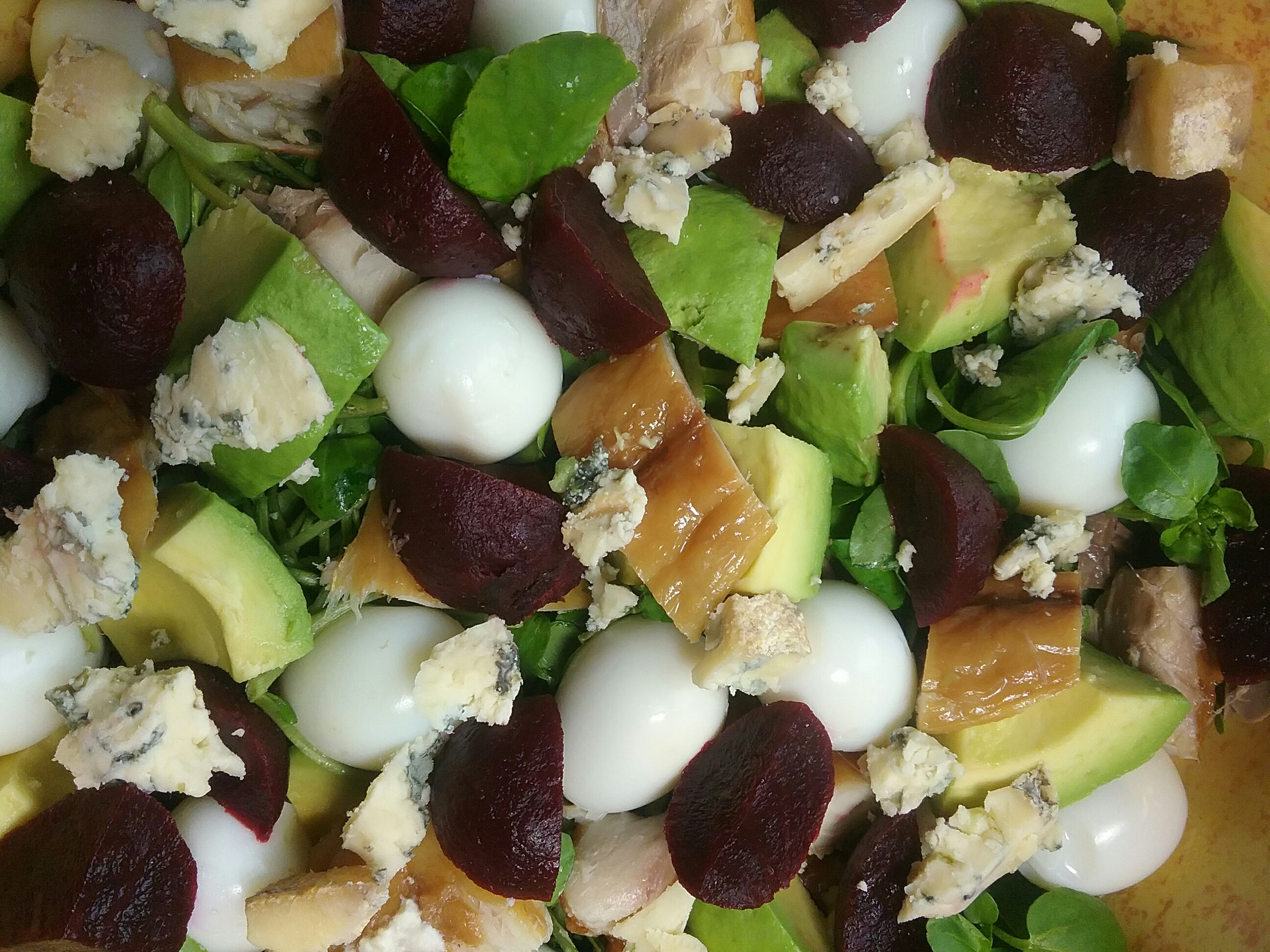
Delicous mix of flavours: Smoked mackerel, quail eggs, beetroot, avocado, watercress and rocket covered in crumbled stilton. A really hearty and filling salad.

Delicous mix of flavours: Smoked mackerel, quail eggs, beetroot, avocado, watercress and rocket covered in crumbled stilton. A really hearty and filling salad.
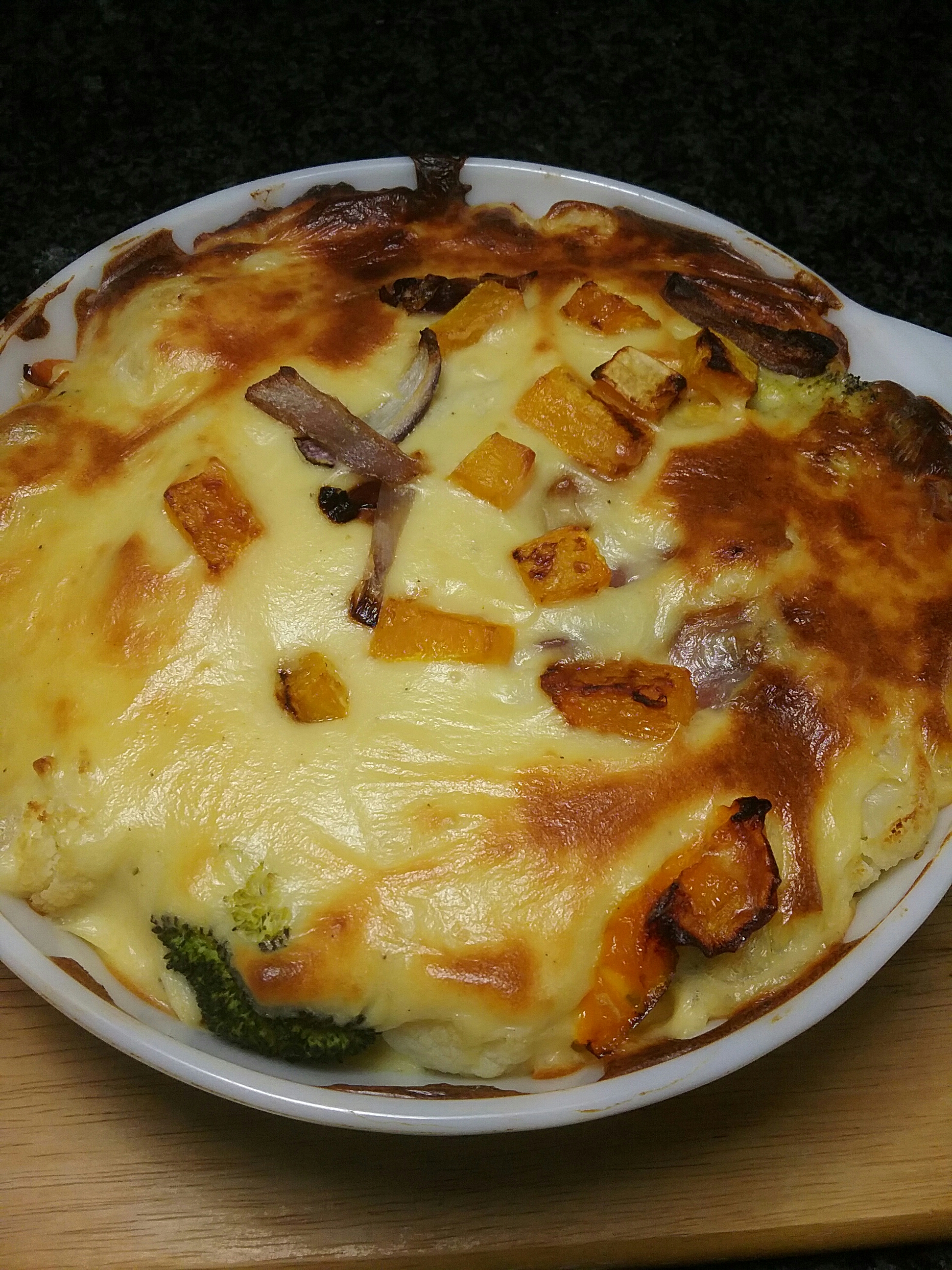 Ingredients:
1/2 butternut squash de seeded and cut in to cubes
1 red onion sliced in to large chunks
1 yellow pepper de seeded and cut in to large pieces
Broccoli and / or cauliflower
Coconut oil
Butter
Milk
Gluten free plain flour
Cheese e.g. cheddar – grated – some for sauce and some to sprinkle on top
Method:
Prepare the squash, onion and pepper. Drizzle with coconut oil and roast in hot oven until cooked – about 35 minutes. Cut the broccoli and cauliflower into large florets and steam until cooked – but firm.Drain thoroughly. Make the cheese sauce with the butter, flour, milk and cheese. Assemble all the cooked vegetables in an oven proof dish and pour the cheese sauce over the top. Sprinkle the remaining grated cheese over the top and bake in a hot oven until hot throughout and golden brown with a crisped cheese top.
I eat it on its own. My husband like to have it with a couple of rashers of grilled bacon placed over the top.
Several weeks ago (17th April to be precise) I gave up meat for 4 weeks to see what would happen – would I feel any better, no different or not as good.
Much to my fascination, I have not eaten it since and more amazingly for this carnivore, I have not missed it. In fact, the other day I cooked some bacon for my husband – I thought this would be the ultimate test as I have never been able to resist the aromas of bacon assaulting my olfactory senses. Not only did I resist, but I found the smell decidedly unpleasant. What is happening!
I know when I first gave up fructose I was told it would take 6-8 weeks to recalibrate. Is this the same with any dietary change? How long does it take to make a lifestyle change become habit?
I make sure I eat a balanced and nutrient diet – getting the macro and micro nutrients I would have ingested from meat sources from other sources.
Before writing this tonight I googled, ‘giving up meat for a month’ – it seems I am not alone !! Not such a threshold adventurer after all…but not quite a lemming either. Just another person who wants to try different ways to improve their health. 🙂
 Salad: roasted butternut squash, tomatoes, radishes, mixed olives, watercress and rocket mixed with a drizzle of apple cider vinegar, tamari and extra virginity olive oil with beetroot and a pickled cucumber.
Trout portion baked with a squeeze of lemon.
 Fresh rhubarb from the garden – sprinkled with light muscovado sugar and roasted until soft.
Buck wheat pancakes:
225 g buckwheat flour 1 large egg
1/4 tsp cinnamon
250 ml milk
Method:
Put the dry ingredients in to a bowl and make a well for the egg. Mix together and slowly add the milk and mix to create a smooth batter.

These are not very sweet just sufficient to soften the dryness of the ginger…perfect with a cup of coffee or with cheese.
Preheat oven to 190c /Gas mark 5 Line a tray with lightly greased baking parchment
Ingredients:
100 g ground almonds 3 tbsps coconut oil
50 g pecans 1 tbsp honey
180 g brown rice flour 100 ml water
2 tbsps ground ginger
Method:
Crush the pecans into a coarse texture. Put all the ingredients in to a bowl and mix. The mixture should create a firm dough (if needed, add a little more water).
Roll out until thin – less than 1/2 cm. Cut out and place on baking tray. Cook for about 10-15 minutes until golden brown. Remove from oven and place on wire rack to cool.
 So simple to coat and roast nuts yourself rather than buying them. This way you know exactly what has been used as ingredients. Place on a baking tray and drizzle with coconut oil. Sprinkle with seasoning of your choice – I used harissa and then roast for about 10 -15 mins at the top of a hot oven. Once golden brown, remove from the oven. I then sprinkle with a pinch of pink Himalayan salt.
This used to always be heard in my house. It was a habit / a daily ritual.
How / when did this habit start? When I think back, I realise this habitual behaviour pattern started in my childhood all those eons ago. This started me thinking about other habits I formed around eating – eating the same everyday for breakfast; eating at the same time everyday; Sunday roast dinner; having a take away meal as a treat on a Friday night; Saturday night treat – meal on a tray in front of the television; the necessity of ‘waste not, want not’ and clearing your plate; the importance of sitting around a table for all the other meals and finally the importance of conversation and discussion at mealtimes.
Thankfully, I have broken all but the last 2 habits (which I feel are ones I value and are good habits). I had to consciously acknowledge these ingrained traits and work hard at overcoming them.
The final habit I have got to grips with is that of hunger v habit. The availability of food and the habitual way of eating had overridden my ability to distinguish between eating for the sake of it and true hunger. Not only had I lost the ability to tell if I was hungry but also if I was full / satiated.
Now, I ask myself, ‘Am I really hungry; or actually thirsty; or just craving something?’ and I no longer clear my plate if I am full having decided it is better for any excess food to go in the bin than be stored as fat on my body! (Reduced portion size means I don’t often waste food – this has helped me control the ‘waste not, want not’ voice in my head!)
I do, of course, still have a pudding sometimes but not as a treat for clearing my plate, or not because I always have one but just because very occasionally…I want one 🙂
 Salad of rocket, radish, tomatoes and sharon fruit.
I have been pondering a couple of thoughts this week and haven’t yet come up with an answer…any thoughts / ideas etc. gratefully received.
The first notion meandering about my brain is that of superfoods. I had just #superfood for one of my instagram postings and it got me thinking. The hashtag was for kale – the latest superfood. When does a food become a superfood? Who decides? What is the criteria. If I think about kale – I used to eat it all the time when I was little. Then, it wasn’t a superfood – just another vegetable on the plate eaten in the same way as Savoy cabbage. As far as I am aware it hasn’t been genetically modified in any way so why the relabelling? The same with avocados. In the 80’s trendy ‘hippie’ types, as my elderly aunt would call people who ate anything that wasn’t meat and two veg, ate the new fruit – avocado. I distinctly remember putting the ‘pear’ in a fruit salad and being deeply disappointed. I also remember the trend of suspending the stone in some water and growing an avocado plant – I grew several. It then went out of fashion for being too calorific. and full of fat as the low-fat diets swept the country. Now of course we know that the fat within this food is good for us. I adore avocado and eat/ drink it daily.
The other thought entwining my grey matter is that of recommended daily intake – food agencies determine using scientific evidence the recommended daily intake of various food stuffs. What I don’t understand is that the daily recommendations vary for different countries…but we are all people just living in different places. The UK recommends at least 5 portions of fruit/veg a day whereas the Australian Government guidelines are 5 portions of vegetables / legumes a day and no more than 2 portions of fruit. It’s different again in Japan – 5-6 portions of vegetable dishes and only 2 portions of fruit.
How can we mere mortals hope to keep up if the facts are always changing?
 Jo's food bites.