Lemon and rosemary infused quinoa stuffed peppers

image

Cup full of quinoa washed thoroughly and cooked. Whilst hot squeeze juice of 1 lemon into it and add 2 cubes of rosemary frozen in olive oil – or a sprig of fresh rosemary. and a dash of olive oil. (I put any leftover fresh herbs in to ice-cube trays and cover with olive / coconut oil and then freeze)

Cut the peppers in half and deseed. Roast for about 10 minutes and then stuff with the quinoa mixture and put back in the oven to roast until the peppers are cooked.

I served this dish with cayenne and olive oil roasted sweet potato and butternut squash chunks (neither peeled) and a chunk of corn on the cob.


But I always have a pudding!

This used to always be heard in my house. It was a habit /  a daily ritual.

How  / when did this habit start? When I think back, I realise this habitual behaviour pattern started in my childhood all those eons ago.  This started me thinking about other habits I formed around eating – eating the same everyday for breakfast; eating at the same time everyday; Sunday roast dinner; having a take away meal as a treat on a Friday night; Saturday night treat – meal on a tray in front of the television; the necessity of ‘waste not, want not’ and clearing your plate; the importance of sitting around a table for all the other meals and finally the importance of conversation and discussion at mealtimes.

Thankfully, I have broken all but the last 2 habits (which I feel are ones I value and are good habits). I had to consciously acknowledge these ingrained traits and work hard at overcoming them.

The final habit I have got to grips with is that of hunger v habit. The availability of food and the habitual way of eating had overridden my ability to distinguish between eating for the sake of it and true hunger. Not only had I lost the ability to tell if I was hungry but also if I was full / satiated.

Now, I ask myself, ‘Am I really hungry; or actually thirsty; or just craving something?’ and I no longer clear my plate if I am full having decided it is better for any excess food to go in the bin than be stored as fat on my body! (Reduced portion size means I don’t often waste food – this has helped me control the ‘waste not, want not’ voice in my head!)

I do, of course, still have a pudding sometimes but not as a treat for clearing my plate, or not because I always have one but just because very occasionally…I want one 🙂


Superfood

I have been pondering a couple of thoughts this week and haven’t yet come up with an answer…any thoughts / ideas etc. gratefully received.

The first notion meandering about my brain is that of superfoods. I had just #superfood for one of my instagram postings and it got me thinking. The hashtag was for kale – the latest superfood. When does a food become a superfood? Who decides? What is the criteria. If I think about kale – I used to eat it all the time when I was little. Then, it wasn’t a superfood – just another vegetable on the plate eaten in the same way as Savoy cabbage. As far as I am aware it hasn’t been genetically modified in any way so why the relabelling? The same with avocados. In the 80’s trendy ‘hippie’ types, as my elderly aunt would call people who ate anything that wasn’t meat and two veg, ate the new fruit – avocado. I distinctly remember putting the ‘pear’ in a fruit salad and being deeply disappointed. I also remember the trend of suspending the stone in some water and growing an avocado plant – I grew several. It then went out of fashion for being too calorific.  and full of fat as the low-fat diets swept the country. Now of course we know that the fat within this food is good for us.  I adore avocado and eat/ drink it daily.

The other thought entwining my grey matter is that of recommended daily intake – food agencies determine using scientific evidence the recommended daily intake of various food stuffs. What I don’t understand is that the daily recommendations vary for different countries…but we are all people just living in different places. The UK recommends at least 5 portions of fruit/veg a day whereas the Australian Government guidelines are 5 portions of vegetables / legumes a day and no more than 2 portions of fruit. It’s different again in Japan – 5-6 portions of vegetable dishes and only 2 portions of fruit.

How can we mere mortals hope to keep up if the facts are always changing?

Asparagus, Asparagus, Asparagus

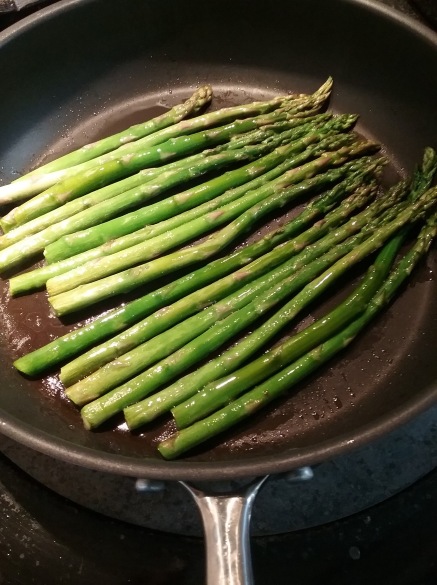
Such a delicious addition / focus of many a dish. I find the quickest and easiest way to cook it is to pan fry it – in coconut oil. Stir occasionally to ensure coated in the oil. It takes 5 – 10 mins on a high heat. 20160326_140310

Here are several different ways we eat it:

20160516_192415

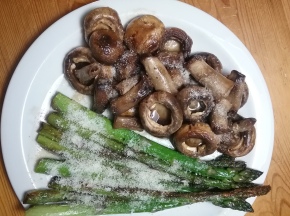
With butter sautéed button mushrooms – sprinkled with parmesan – starter or main.

20160507_132306

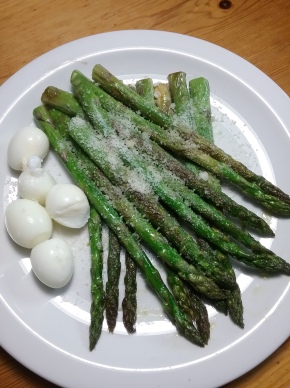
Served with quail eggs and sprinkled with parmesan – a delicious combination of flavours. Perfect as a starter – 3 eggs and 5 stems or main dish.

20160326_141343

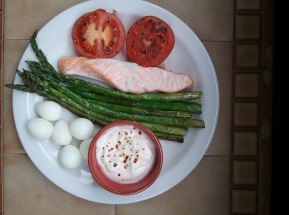
Served with quail eggs, roasted salmon, tomatoes and a Greek yoghurt and chilli flake dip.

20160516_202104

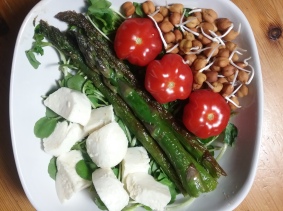
Cold in a salad – here with sprouted brown chick peas, tomatoes and mozzarella on a bed of watercress.

…and probably my favourite…

090416l

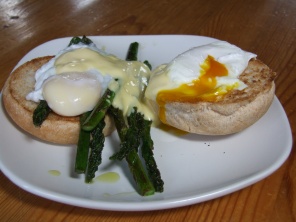
Served on gluten-free muffins with poached free range eggs and serves with a generous dollop of hollandaise sauce.

Quinoa tabbouleh topped with free range eggs

A simple one pan dish

20160510_194428

Ingredients:

1 cup of quinoa well rinsed, cooked and drained

1 red onion – chopped

2 peppers – roughly chopped

Handful of kale

Tamari (soy sauce if not needing gf)

1 – 2 tsp Garam masala

Coconut oil

2 free range eggs per person

Method

In a large frying pan, saute the onions and peppers in coconut oil. Add Garam Masala and the kale. Cook until the veg is the desired crunch. Add the cooked quinoa and generous splash of Tamari. Once heated through, crack the eggs in to small wells and cook until desired consistency.


Turmeric milk

20160503_112629

A delicious drink that is packed full of goodness and very simple to make.

Ingredients:

Mug of full fat milk

1 1/2 tsp turmeric powder

1 tsp cinnamon / piece of cinnamon stick

1 tsp ground ginger / finely chopped cm piece of fresh ginger

Pinch of black pepper

Method:

Put all the ingredients in to a saucepan and heat gently bringing to the boil. Remove from  the heat and if you have used fresh ginger and cinnamon stick – strain the liquid.

Drink and enjoy – I often have this with a piece of 85% dark chocolate.


Salad – quail eggs, fresh figs, mozzarella and tomatoes

28-03-lunch

There is something so delicious about fresh figs in a salad. Quail eggs are little powerhouse packets of goodness – I am so lucky to have my own hardworking ladies.

I served this salad on a gluten free wrap  and added shredded cabbage, onion and carrots- once rolled was difficult to eat but well worth the challenge!

I am in contol of my food…it no longer controls me

For a long time I, like many others I have talked to, seem to have been in the pursuit of the perfect diet – the key few ‘must have’ ingredients or ‘must do’ approaches to eating. I have followed the latest hot topic dietary approaches and listened to all the ‘experts’ wanting to share their ‘dietary magic’. At times I have been lulled in to the promises of quick fix approaches – which have ‘worked’- but of course any weight loss has slowly returned or different diet approaches have not be sustainable. If I have followed a restrictive diet my emotional reaction has always ended in rebellion.

I have realised over the last year that for me to be successful in maintaining my diet -not on a diet – I must firstly identify my own individual appetite drivers and my food choices. Once I understood my triggers to eat, triggers not to eat I then became able to manage my weight. Fructose was a trigger for me – so I removed it. Snacking and being unaware was another trigger.

I now have a sustainable positive mindset about choosing the foods I eat and the amounts of food my body wants. I actively listen out for the feelings of satiety and most importantly and totally amazingly for someone for whom bulimia has been a constant companion for so, so many years I am eating guilt free. It has been such a liberating experience – I am now free from my bingeing habits and the suffocating feeling that food is controlling me.

Sprouting

In the 70’s and 80’s it was trendy to have various pulses sprouting in jars around the house. I remember having jars of alfalfa and mung beans everywhere…along with the obligatory mustard and cress on cotton wool – slightly yellowing and curled at the edges. I did this because ‘everyone else’ did. I did enjoy them but the ‘fad’ soon ended.

Now, all these years on, once again I have jars with sprouting pulses in cupboards and in dark corners.  This time however, I do it not only because I enjoy eating them but also because I know the health benefits that eating them brings.

I know that soaking and sprouting de-activates the acids and enzyme inhibitors present in the pulses preventing them from growing until the conditions are favourable. This de-activation then enables our bodies to digest and absorb the vitamins and minerals more readily.

Now I sprout a wide variety of legumes – lentils, chickpeas, quinoa and (of course my old favourite) mung beans,  to name few.

                                  Green lentil                    Quinoa                              Mung bean

I’m yet to try chia seeds – I’m sure they will but am just not sure how to as when they are soaked they get a mucilaginous coating. Any advice?